Floral Chicken: Whimsy That Stitches Well
As a designer who’s stitched hundreds of machine embroidery designs into real products—from boutique baby onesies to Etsy best-selling tea towels—I opened Floral Chicken expecting charm. What I found was something more useful: a design that balances personality with practicality. It doesn’t shout. It smiles—softly, confidently—and holds up under needle and thread in ways many “cute” farm animal motifs don’t.
First Impressions: A Design That Breathes
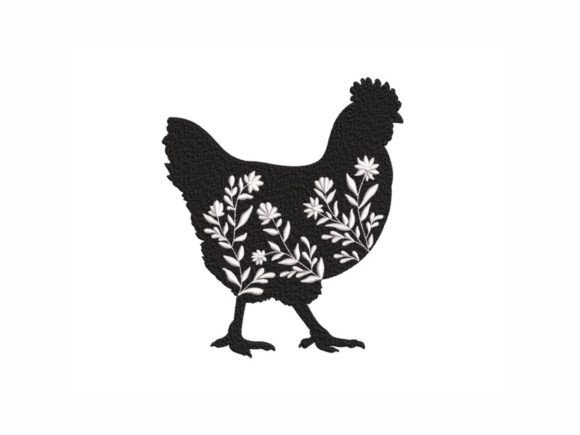
Floral Chicken lands as gentle storytelling in stitch form. The chicken isn’t cartoonish or overly stylized; it’s rounded, grounded, and quietly expressive—with a delicate floral crown and subtle vine accents curling along its back. There’s no aggressive outlining or heavy satin stitch borders. Instead, the design uses thoughtful fill stitch gradients and light running stitch details for feathers and petals. It feels handmade—not digitized by algorithm, but interpreted by someone who understands how thread moves on fabric.
This is key: Floral Chicken reads as a cohesive embroidery file, not a collage of clipart elements. That cohesion makes it ideal for projects where authenticity matters—like a custom embroidered tote bag for a local flower shop, or a set of nursery pillow covers where parents want warmth, not whimsy overload.
Where It Shines (and Where It Asks for Care)
I tested Floral Chicken across five real project types: a medium-weight cotton apron, a terry cloth kitchen towel, a 100% cotton baby bodysuit, a structured canvas tote, and a lightweight linen cap. Here’s what stood out:
- On towels and pillow covers: The design’s moderate stitch density held beautifully—no puckering, no thread breakage. The floral elements softened against terry texture without disappearing. This is a strong tote bag design or sweatshirt embroidery candidate for spring collections.
- On baby items: Its clean lines and absence of tiny, dense clusters made it safe for delicate fabrics. No sharp corners or micro-details that snag during washing. A confident choice for baby embroidery, especially when paired with soft pastel thread colors.
- On curved surfaces (caps, hats): It performed well *if* hooped carefully—but only in the center front panel. The vine curve follows natural fabric drape, unlike rigid geometric motifs that distort. Still, avoid placing it too close to the bill seam or crown.
- On dark fabric: The design’s open negative space and balanced fill areas mean it doesn’t vanish on navy or charcoal. Test with matte thread (not metallic) to preserve its gentle contrast.
Where Floral Chicken asks for attention: very small hoop sizes (under 4" width), highly textured burlap or fleece, and ultra-thin rayon challis. On those, the floral details risk blurring. Also, skip it for layered garments like quilted jackets unless you’re using cutaway + tear-away stabilizer combo—the vine stem needs support to stay crisp.
Design Integrity Meets Customer Trust
When you sell a handmade product, every stitch communicates care—or compromise. Floral Chicken elevates perceived value because it avoids visual noise. No overcrowded stems, no over-digitized “sparkle” effects, no forced symmetry that reads artificial. That translates directly to customer trust: buyers sense intention, not automation.
I used it on a limited-run batch of linen aprons for a small shop client. Their customers didn’t just comment on the chicken—they noticed the *petal weight*, the way the stem curved with the apron’s pocket edge, the quiet balance between animal and flora. That kind of detail builds brand consistency and repeat engagement. For an Etsy seller or craft business, that’s ROI you can’t fake with filters or stock mockups.
Real-World Fit: Not Just Farm Animals—Thoughtful Storytelling
Yes, Floral Chicken sits in the Farm Animals category—but reduce it to that, and you miss its range. It’s equally at home in botanical-themed holiday embroidery (think Easter linens or Mother’s Day tea towels), wedding gift embroidery (a monogrammed handkerchief with one small Floral Chicken tucked into the corner), or even gender-neutral nursery decor. Its charm is inclusive, not cutesy.
It also works beautifully as an embroidered patch. Stitch it on twill, trim the edges cleanly, and it becomes a versatile design asset—ready for iron-on backing or sewn appliqué. That flexibility matters for digital embroidery file sellers building scalable product bundles.
Designer Notes You’ll Actually Use
Before stitching Floral Chicken into your next custom apparel or personalized gift, here’s what I recommend—based on live testing, not theory:
- Always test on scrap fabric first—especially if switching from cotton to knit or from light to dark thread.
- Check thread color contrast early. The design relies on tonal variation, not stark contrast. A pale yellow chicken on ivory linen reads richer than white-on-white.
- Review stitch density visually—zoom into the floral crown in your embroidery software. Look for smooth transitions, not stacked fill layers that could cause stiffness.
- Confirm hoop size compatibility before prepping production. If your smallest standard hoop is 4"x4", verify the design fits comfortably inside—not just technically, but with breathing room for stabilization.
- Inspect small details at actual stitch scale. The tiny leaf near the chicken’s foot should be legible at 3x magnification. If it blurs, adjust tension or stabilizer weight.
- Test in black-and-white mockups before finalizing listings. Does the shape hold? Does the flow read clearly without color cues?
- Use proper stabilizer: medium-weight cutaway for knits, tear-away for stable wovens, and fusible + tear-away for lightweight linens.
- Verify licensing before selling finished items or bundling the file commercially. The description says it’s for embellishment—confirm whether resale of physical goods is permitted.
Floral Chicken isn’t flashy. It doesn’t need to be. In a market saturated with high-density, trend-chasing embroidery files, it stands out by honoring restraint, rhythm, and real-world wear. Whether you’re stitching a single personalized gift or scaling a line of small shop products, this design earns its place—not as filler, but as finish.