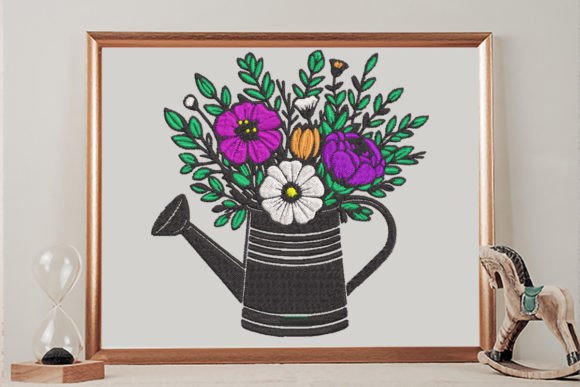
Floral Watering Can
A Craft Fair Designer’s First Look: Whimsy That Sells
As an embroidery designer who’s packed, stitched, and sold at over 40 craft fairs—from downtown pop-ups to regional spring markets—I know what stops a shopper mid-aisle. Floral Watering Can lands exactly where it needs to: soft but intentional, nostalgic but fresh, gentle but memorable. It reads as whimsical farmhouse—not overly rustic, not too modern, and never cutesy in a way that ages poorly. That balance is gold for handmade product lines targeting spring shoppers, gift buyers, and home decor lovers.
Where Floral Watering Can Shines on Real Craft Fair Products
This machine embroidery design doesn’t shout—it invites. And that makes it unusually versatile across high-turnover craft fair items:
- Tote bag design: Perfect centered on the front of a natural canvas or oat linen tote. Large enough to read from three feet away, small enough to leave room for branding or a subtle tagline.
- Apron embroidery: Ideal above the pocket or along the bib edge. Its organic shape flows with apron curves, and the floral detail reads as hand-finished—even when machine-stitched.
- Tea towel embroidery: A standout on flour-sack or waffle-weave towels. The watering can’s silhouette holds up beautifully against textured fabric, and the floral accents add just enough detail without overwhelming.
- Embroidered patch: Works cleanly at 3–3.5 inches. Cut-and-sew patches fly off craft fair tables—especially when they’re themed (Spring! Gardening! Home!) and feel cohesive with a maker’s brand.
- Pillow cover & pouch embroidery: Scales well both large (12" x 12" pillow front) and small (4" x 6" drawstring pouch). The design’s balanced negative space prevents visual fatigue—a key win for booth displays where customers scan dozens of items in seconds.
What Makes It Booth-Ready (and Etsy-Listings-Ready)
Floral Watering Can succeeds where many spring-themed embroidery files fall short: it’s instantly legible. No squinting. No “what is that?” confusion. The watering can anchors the composition; the florals soften—not distract. That clarity translates directly to stronger printable mockups, cleaner Etsy listings, and faster customer recognition in person.
It’s also highly repeatable for batch production. With moderate stitch density and no ultra-fine linework or micro-lettering, it runs reliably across machines and stabilizer setups. You won’t lose hours troubleshooting thread breaks or re-hooping for tiny details. For small shop product lines—especially those built around seasonal collections—this reliability cuts production time and builds consistency.
Careful-Use Notes Every Embroidery Designer Should Check
Even charming designs have limits. Here’s what to test before committing to 50 tea towels or 30 embroidered caps:
- Dense stitch areas: The base of the watering can and clustered flower centers may require medium-weight cutaway stabilizer on lightweight fabrics—or tear-away + topping on textured towels.
- Curved cap surfaces: Avoid placing the full design across the crown. Instead, use a simplified version (if available) or position it cleanly on the front panel where hoop pressure stays even.
- Dark fabric: Light thread colors will need extra coverage. Test satin-stitch fill density and consider adding a white underlay if stitching on navy, charcoal, or deep olive.
- Small sizes: Below 2.75", the floral sprigs risk blurring into a blob. Stick to ≥3" for patches or pouches—and always run a physical sample, not just a digital preview.
- Fabric texture: On heavy terry cloth or bouclé, reduce top tension slightly and verify stitch definition. A light steam press post-stitch helps lift flattened details.
How It Lifts Your Handmade Product Value
Customers don’t buy embroidery—they buy feeling. Floral Watering Can delivers quiet confidence: it says “thoughtfully made,” not “mass-produced.” That perception lifts price tolerance, supports premium positioning, and strengthens brand consistency across your line—whether you’re selling at a farmers’ market stall or scaling digital embroidery file sales online.
In your booth display, this design adds visual rhythm. Pair it with solid-color linens, neutral ceramics, or kraft-paper tags, and it becomes a focal point without competing. On social media previews or Etsy banners, it photographs cleanly—no glare, no lost detail—making your printable mockup conversion rates climb.
Designer-to-Designer Production Checklist
Before cutting your first fabric piece or uploading to your digital shop:
- Test the embroidery file on scrap fabric that matches your final product (e.g., actual tea towel weave, not cotton broadcloth).
- Check thread contrast across at least three fabric colors—especially your top three bestsellers.
- Review spacing between elements: does the watering can “breathe” next to text or other motifs? Leave at least ¼" margin if combining designs.
- Confirm hoop size compatibility—some versions may require a 5x7" hoop minimum. Don’t assume.
- Inspect stitch density in the floral clusters. If it looks muddy on screen, it’ll look muddy on fabric.
- Use the right stabilizer for your fabric weight and end use—especially critical for commercial embroidery on resale items.
- Create at least one real mockup—not digital. Hold it, fold it, photograph it in natural light. Does it make *you* pause?
- Compare fabric colors side-by-side: ivory vs. oat vs. unbleached canvas change how florals read.
- Confirm commercial licensing before selling finished products. This is non-negotiable for Etsy sellers and boutique makers.
Final Thought: A Spring Staple, Not a Seasonal Gimmick
Floral Watering Can isn’t just another embroidery file for your collection—it’s a quietly strategic craft fair product anchor. It bridges the gap between spring trend and lasting appeal, works across categories without feeling generic, and supports both physical handmade product lines and digital embroidery file sales. When your table is crowded and attention is scarce, charm with clarity wins every time. And this design? It delivers both.